


Driving 240 In snow


Contributing Member
Joined: Nov 2004
Posts: 831
From: In a 240 near you
A guy near me puts 50lb bag of sand (or two) with some good winter tires and he says it drives great. I will not be driving my 240 when it snowing however as even if you can drive others can't and could still mess it up.


Contributing Member
Joined: Jun 2005
Posts: 652
From: Cape Cod, Ma.
put weight in back - YES
Deflate psi- NO
This is one of the most common mis-conceptions that people have.
I've lived in new england my whole life, and my family generations before.
We get several big snow-storms a year here.
here's how it works:
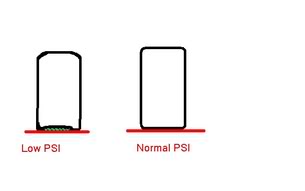
When you deflate the tire, the pressure and weight from the car is forced towards the edges of the rims. Therefore, the outer edges of the tires exert more pressure than the middle of the tires. An are of low pressure, from lack of PSI causes the middle of the tire to form an arc. When proper PSI is put into a tire, the force is exerted equally, and more of the tire is in contact with the ground.
When more rubber is on the ground, there is more traction. The low PSI work in the sand, because the sand lets you sink, but it eventually compacts on itself and the tires "pankake" over the sand. However, in the snow, it compacts, but becomes slippery, just like in water, when its slippery, the more rubber touching and exerting force, the easier it will be to regain traction.
'nuff said
Deflate psi- NO
This is one of the most common mis-conceptions that people have.
I've lived in new england my whole life, and my family generations before.
We get several big snow-storms a year here.
here's how it works:
When you deflate the tire, the pressure and weight from the car is forced towards the edges of the rims. Therefore, the outer edges of the tires exert more pressure than the middle of the tires. An are of low pressure, from lack of PSI causes the middle of the tire to form an arc. When proper PSI is put into a tire, the force is exerted equally, and more of the tire is in contact with the ground.
When more rubber is on the ground, there is more traction. The low PSI work in the sand, because the sand lets you sink, but it eventually compacts on itself and the tires "pankake" over the sand. However, in the snow, it compacts, but becomes slippery, just like in water, when its slippery, the more rubber touching and exerting force, the easier it will be to regain traction.
'nuff said

Originally posted by Cape 240
put weight in back - YES
Deflate psi- NO
This is one of the most common mis-conceptions that people have.
I've lived in new england my whole life, and my family generations before.
We get several big snow-storms a year here.
here's how it works:

When you deflate the tire, the pressure and weight from the car is forced towards the edges of the rims. Therefore, the outer edges of the tires exert more pressure than the middle of the tires. An are of low pressure, from lack of PSI causes the middle of the tire to form an arc. When proper PSI is put into a tire, the force is exerted equally, and more of the tire is in contact with the ground.
When more rubber is on the ground, there is more traction. The low PSI work in the sand, because the sand lets you sink, but it eventually compacts on itself and the tires "pankake" over the sand. However, in the snow, it compacts, but becomes slippery, just like in water, when its slippery, the more rubber touching and exerting force, the easier it will be to regain traction.
'nuff said
put weight in back - YES
Deflate psi- NO
This is one of the most common mis-conceptions that people have.
I've lived in new england my whole life, and my family generations before.
We get several big snow-storms a year here.
here's how it works:
When you deflate the tire, the pressure and weight from the car is forced towards the edges of the rims. Therefore, the outer edges of the tires exert more pressure than the middle of the tires. An are of low pressure, from lack of PSI causes the middle of the tire to form an arc. When proper PSI is put into a tire, the force is exerted equally, and more of the tire is in contact with the ground.
When more rubber is on the ground, there is more traction. The low PSI work in the sand, because the sand lets you sink, but it eventually compacts on itself and the tires "pankake" over the sand. However, in the snow, it compacts, but becomes slippery, just like in water, when its slippery, the more rubber touching and exerting force, the easier it will be to regain traction.
'nuff said
I've been doing it every year since, everytime I go to the mountains to go snowboarding...
I've been on Icy conditions with properlly flatted tires, you can turn left or right, even hit the brakes, the car will usually glide straight. Thats why you deflate.......
Last edited by BigVinnie; Aug 23, 2005 at 07:59 PM.


Registered User
Joined: Jan 2004
Posts: 8
From: Dunrobin, Ontario, Canada
In my experience, I keep the pressure lower in the summer, and higher in the winter. Ever tried walking on ice with snowshoes? You'll get more surface area and no traction!
I also leave 4 x 25lb bags of salt in the trunk, and use 4 season tires that are LESS than 2 years old, after that, get some good winter tires.
On my other cars, I have 15 inch wide rear tires. There ain't no way I'd be ever able to drive that in the snow....
I also leave 4 x 25lb bags of salt in the trunk, and use 4 season tires that are LESS than 2 years old, after that, get some good winter tires.
On my other cars, I have 15 inch wide rear tires. There ain't no way I'd be ever able to drive that in the snow....

Registered User
Joined: May 2005
Posts: 45
From: vermont
The whole idea is to cut throw t he snow to git to the ground where the tracktion is. So skinny tires work beter in the snow then fat ones. I saw the same thing on dicover with that toyota. They where running on ice and snow with no ground to fall to. so n that cause you would want big fat tires to pack the snow for tracktion. But we live in the real world where the roads are plowed and salted or sanded and people have driven on it you want to see the ground. On ice you want studded tiers or chains. I just bought a 93 escort for 500. Why. So when I hit that snow bank or go off the road I can say o well. If I wrecked my 240 I would be a little more upset. I like to have fun in the snow but there are bigger risk when dealing with snow and ice. In my last post i said better car. I meant a car you can dent up or more. The 240 are a better car. 

Contributing Member
Joined: May 2005
Posts: 1,634
From: Hershey, PA
Originally posted by Madman Stephan On my other cars, I have 15 inch wide rear tires. There ain't no way I'd be ever able to drive that in the snow....
In the snow, the lower psi helps the tire have more surface on the ground... inflating it makes the tire push and compact the snow instantly, so you slide everywhere... deflating allows the tire to give a little and form around the snow and have more surface area to grip...
Cape, the inflated/deflated tire diagram you have is true, but in warn weather... unless they keep your roads super duper salted and cindered.
BigV... where do you board at?
Registered User
Joined: Jan 2004
Posts: 8
From: Dunrobin, Ontario, Canada
What kind of cars have 15" wide rear tires?
I have a 1970 Dodge Challenger and a 1973 Plymouth Roadrunner. The reason behind the wide tires is due to the high HP generated by the engine would make the tires slip more than anything else on fast take-off's. Now, that being said, it only works on dry pavement. I couldn't even think of driving these cars in the winter let alone with those tires on.....
The logic of wide tires offering more traction is only valid on dry pavements. There's another little factor called friction coeeficient that comes into play. You ABSOLUTELY need to increase tire pressure in the winter to reduce the surface area and increase the PSI ratio (car's weight : total contact surface on ground).
If you snowboard, you'll understand that the width of your board has been engineered to give you the maximum acceleration, best control possible. If you board was only 4" wide, it would sink in the snow, but although control would increase, speed would be reduced. If it was 24" wide, you would be ableto go at much higher speed, but would have much less control.
If you're a hockey player, then you know why they use skates, and not snowshoes.....
Try it out this winter in a parking lot after a snowstorm. I know that I'm 100% correct on this one. Trust me!
I have a 1970 Dodge Challenger and a 1973 Plymouth Roadrunner. The reason behind the wide tires is due to the high HP generated by the engine would make the tires slip more than anything else on fast take-off's. Now, that being said, it only works on dry pavement. I couldn't even think of driving these cars in the winter let alone with those tires on.....
The logic of wide tires offering more traction is only valid on dry pavements. There's another little factor called friction coeeficient that comes into play. You ABSOLUTELY need to increase tire pressure in the winter to reduce the surface area and increase the PSI ratio (car's weight : total contact surface on ground).
If you snowboard, you'll understand that the width of your board has been engineered to give you the maximum acceleration, best control possible. If you board was only 4" wide, it would sink in the snow, but although control would increase, speed would be reduced. If it was 24" wide, you would be ableto go at much higher speed, but would have much less control.
If you're a hockey player, then you know why they use skates, and not snowshoes.....
Try it out this winter in a parking lot after a snowstorm. I know that I'm 100% correct on this one. Trust me!

Thread
Thread Starter
Forum
Replies
Last Post
smokey240sx
NA Motor
4
Jan 24, 2005 05:33 PM